Category: Blog

Your blog category

  • Indian Stock Market Review 2025: Nifty’s 10th Winning Year & Smallcap Reality Check

    Indian Stock Market Review 2025: Nifty’s 10th Winning Year & Smallcap Reality Check

    As the final bell rings on December 31, 2025, the Indian equity markets have concluded a year that can best be described as a “Flight to Quality.” While the headline indices like the Nifty 50 and Sensex extended their historic winning streak to a 10th consecutive year, the story beneath the surface was far more complex. From the resurgence of the banking sector to a much-needed reality check in small-cap stocks, 2025 was a masterclass in market cycles.

    The Final Scoreboard: 2025 Index Performance

    Index2025 Closing PriceAnnual Change (%)
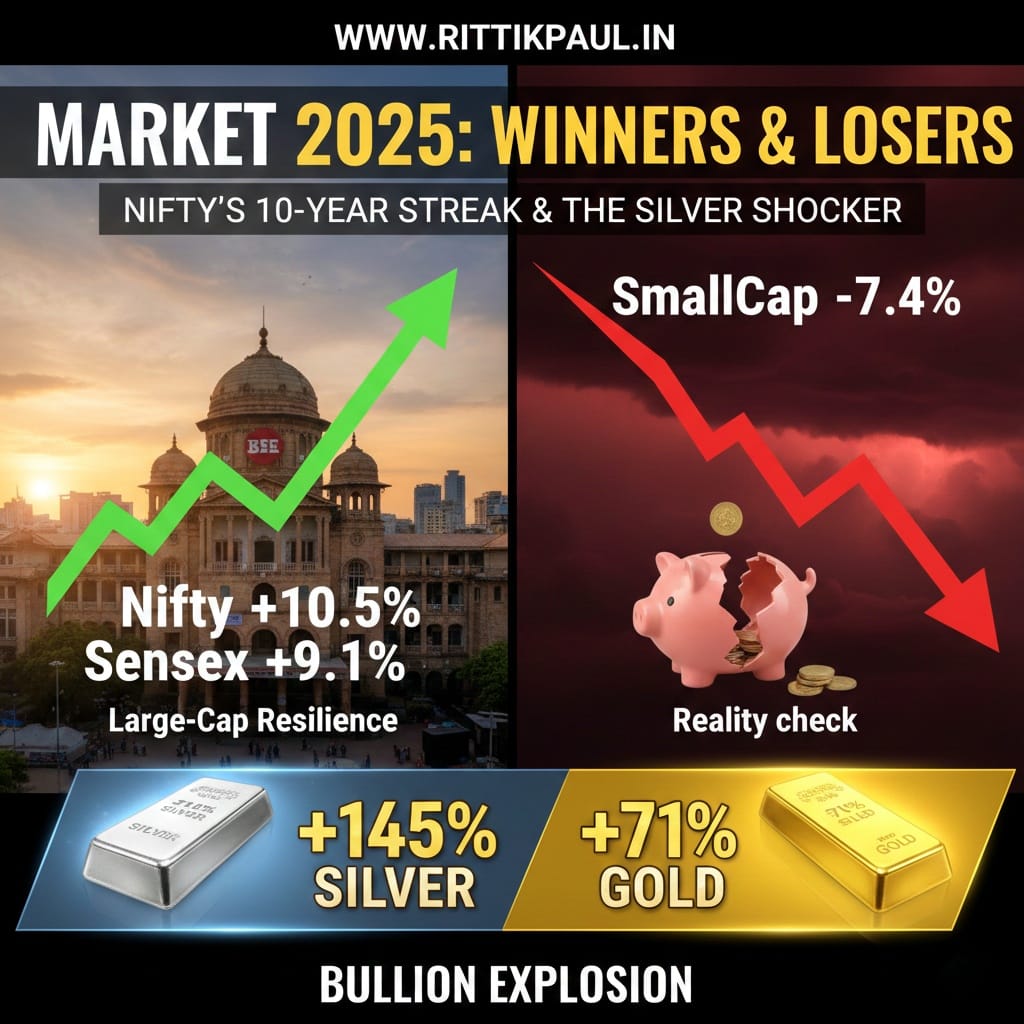
    Nifty 5026,136.35+10.53%
    Sensex85,219.74+9.06%
    Nifty Bank59,615.85+16.73%
    Nifty Midcap 15022,048.35+4.80%
    Nifty Smallcap 25016,490.65-7.44%

    1. Large-Cap Shield: Nifty & Sensex Defy the Odds

    For the 10th consecutive year, India’s primary benchmarks ended in the green. The Nifty 50 officially breached the 26,000 mark in 2025. This resilience was fueled by a record-breaking year for SIPs, which neutralized the aggressive selling by Foreign Institutional Investors (FIIs) who exited due to “Trump Trade” uncertainties and a strengthening US Dollar.

    2. Banking: The Engine of Growth

    The Nifty Bank was the star of the broad indices, rising over 16%. The banking sector benefited from the RBI’s gradual shift in monetary policy and a significant “cleanup” of corporate balance sheets. Private and PSU giants alike reported healthy credit growth, making banking the preferred “safe haven” within equities.

    3. The Small-Cap Reality Check

    2025 was the year the “Smallcap Bubble” finally met a needle. After two years of exponential growth, the Nifty Smallcap 250 corrected by 7.44%. Investors shifted their focus from “growth at any price” to “earnings quality,” leading to a healthy consolidation in stocks with stretched valuations.

    4. The 2025 Powerhouse: Top 3 Outperforming Indices

    Beyond the broad indices, specific sectors delivered “multi-bagger” style returns:

    • Nifty PSU Bank (+30.5%): The undisputed champion of the year as state-owned banks outperformed private peers on improved margins.
    • Nifty Metal (+29.0%): Benefited from global supply disruptions and new domestic safeguard duties on steel imports.
    • Nifty Auto (+23.4%): Driven by a rural recovery and GST rationalization on two-wheelers and small cars.

    5. Bullion Breakout: Silver Steals the Show

    While equities saw steady growth, the bullion market witnessed an explosive “Supercycle.” In 2025, Silver became the best-performing asset class globally, vastly outshining Gold and Stocks.

    • Silver (+145%): Skyrocketed to nearly ₹2.40 Lakh/kg, driven by massive industrial demand in AI data centers and Solar energy.
    • Gold (+71%): Surged to ₹1.36 Lakh/10g as geopolitical tensions and a weakening Dollar pushed investors toward the ultimate safe haven.

    2025 proved that in times of global uncertainty, “Real Money” (Gold & Silver) can offer better protection and higher returns than the stock market.

    Key Market Drivers in 2025:

    Three major factors defined the price action this year:

    • The “Trump Trade” & Tariffs: Global markets spent the latter half of the year adjusting to new US trade policies. This created significant volatility in export-heavy sectors like IT and Pharma as investors weighed the impact of potential new tariffs.
    • IPO Frenzy: India saw a record-breaking year for IPOs, with major tech and manufacturing firms raising over ₹1.7 trillion. While exciting for the primary market, this massive capital requirement often sucked liquidity away from the secondary market, contributing to the mid-cap slowdown.
    • The Rise of Manufacturing: The “Make in India” sentiment remained a powerful theme. Government incentives and a focus on self-reliance continued to support Defense and Engineering stocks, which remained resilient even when the broader market felt the heat.

    Final Verdict: Why 2026 Looks Very Bright

    While 2025 was a year of consolidation and “cleaning out the froth,” the stage is now set for a powerful upcycle.

    The biggest catalyst heading into 2026 is the shift in global and domestic monetary policy. With inflation finally cooling, the Reserve Bank of India (RBI) has begun slashing repo rates (down to 5.25% by Dec 2025). As interest rates continue to trend downward, we are entering a phase of increased systemic liquidity. Furthermore, as central banks globally pivot toward quantitative easing and liquidity infusion to support growth, the “cost of money” is dropping. Historically, this environment is exceptionally bullish for equities. With cheaper borrowing costs for corporations and a surge in investable cash, the upcoming years are positioned to be very good for Indian investors. The strategy for 2026? Stay positioned in quality, watch for the return of FII flows, and ride the liquidity wave.
    If you find this article informative, please share it with your network.

  • RBI Announces Major Liquidity Injection: ₹2 Lakh Crore OMO and $10 Billion Swap to Stabilize Markets

    RBI Announces Major Liquidity Injection: ₹2 Lakh Crore OMO and $10 Billion Swap to Stabilize Markets

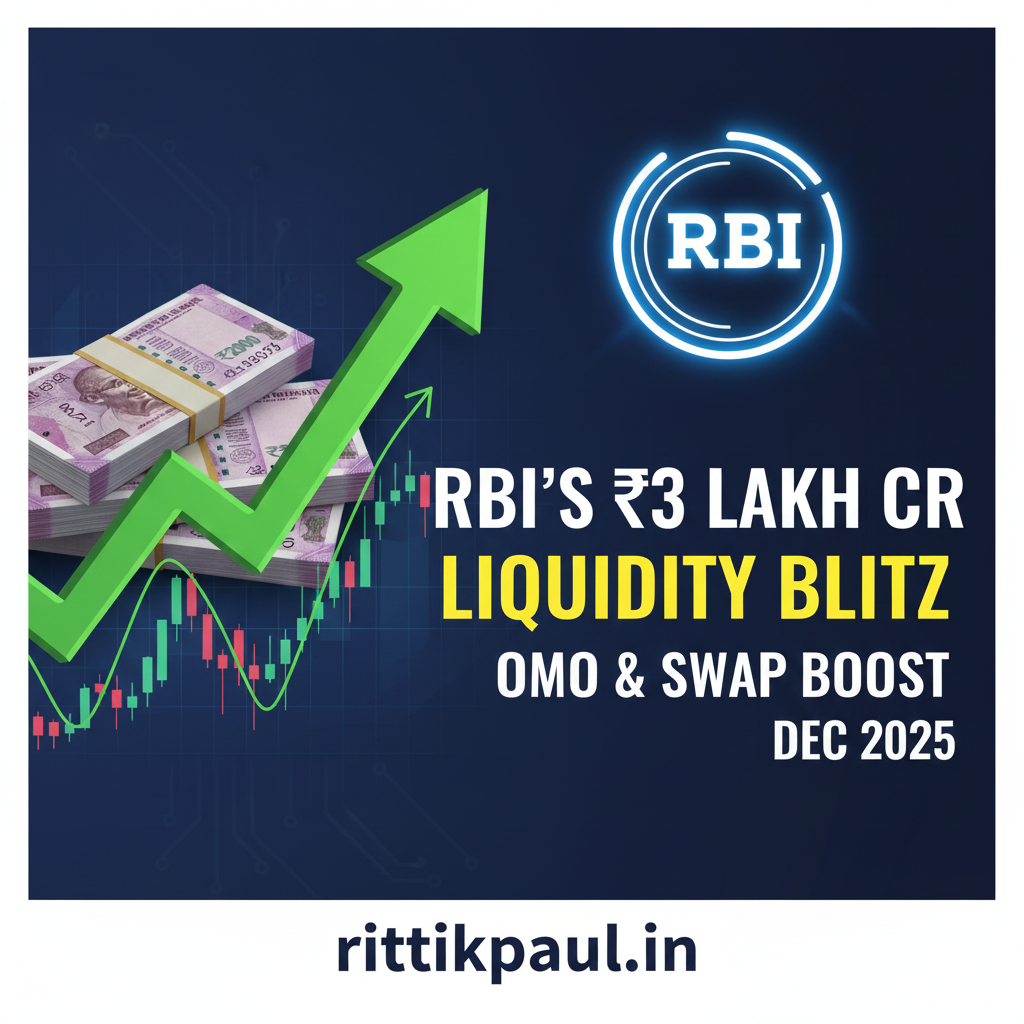
    In a significant year-end move, the Reserve Bank of India (RBI) has unveiled a dual-action strategy to tackle tightening financial conditions. With an aggressive focus on injecting durable liquidity, the central bank is set to launch a massive ₹2 lakh crore Open Market Operation (OMO) alongside a $10 billion USD/INR buy-sell swap.
    These measures are designed to ensure smooth monetary transmission and prevent a “growth scare” as we head into 2026.


    Key Highlights of the RBI Liquidity Measures

    To combat system liquidity that recently turned negative, the RBI is deploying two powerful tools:

    1. ₹2 Lakh Crore Open Market Operations (OMO)

    The RBI will conduct purchase auctions of Government of India securities to pump money directly into the banking system.

    • Total Amount: ₹2,00,000 crore.
    • Execution: Four tranches of ₹50,000 crore each.
    • Schedule: Auctions are slated for Dec 29, 2025, Jan 05, 2026, Jan 12, 2026, and Jan 22, 2026.

    2. $10 Billion USD/INR Buy-Sell Swap

    To further facilitate rupee liquidity, the RBI will execute a foreign exchange swap auction.

    Auction Date: January 13, 2026.

    Tenor: 36 months (3 years).

    Mechanism: In this buy-sell swap, the RBI initially buys dollars from banks to inject rupees and agrees to sell them back three years later.

    Market Implications: What This Means for You

    These aggressive actions have immediate consequences for the broader Indian economy and investment landscape.

    • Lowering Bond Yields: By purchasing government bonds, the RBI creates demand that helps cool off rising yields. Analysts expect the benchmark 10-year yield to retreat toward the 6.5% mark.
    • Currency Stability: With the Rupee recently touching record lows near ₹90 per dollar, these swap operations help stabilize the currency and reduce abnormal volatility.
    • Credit Conditions: Ample liquidity ensures that credit remains affordable for housing, vehicles, and SME business loans, fostering a supportive ecosystem for multi-quarter growth.

    Why is the RBI Intervening Now?

    System liquidity hit a strained period in mid-December 2025, pushing short-term call rates above the policy repo rate. This pre-emptive intervention signals that the RBI is prioritizing macroeconomic stability to meet the productive requirements of a 7.3% projected GDP growth for FY26.

    My Take: A Green Signal for Investors?

    The RBI’s ₹3 lakh crore liquidity blitz is more than just a banking adjustment; it’s a proactive lifeline for the broader financial ecosystem. By anchoring long-term yields and ensuring a steady cash flow, the central bank is creating a foundation for a stable financial environment in 2026.

    Why this matters for your portfolio: It is no secret that the Indian stock market has delivered relatively muted returns over the last two years. Many retail investors have been waiting for a catalyst to break this cycle of consolidation. These liquidity-boosting steps are exactly that catalyst. By lowering borrowing costs and increasing the money supply, the RBI is effectively opening the sluice gates for capital to flow back into the equity markets. For the patient investor, this move significantly increases the likelihood of seeing “green portfolios” once again as we head into the new year.

    If you find this article informative, please share it with your network.

  • TATA Capital’s Damp Squib Debut: A Cautionary Tale for Unlisted Market Investors

    TATA Capital’s Damp Squib Debut: A Cautionary Tale for Unlisted Market Investors

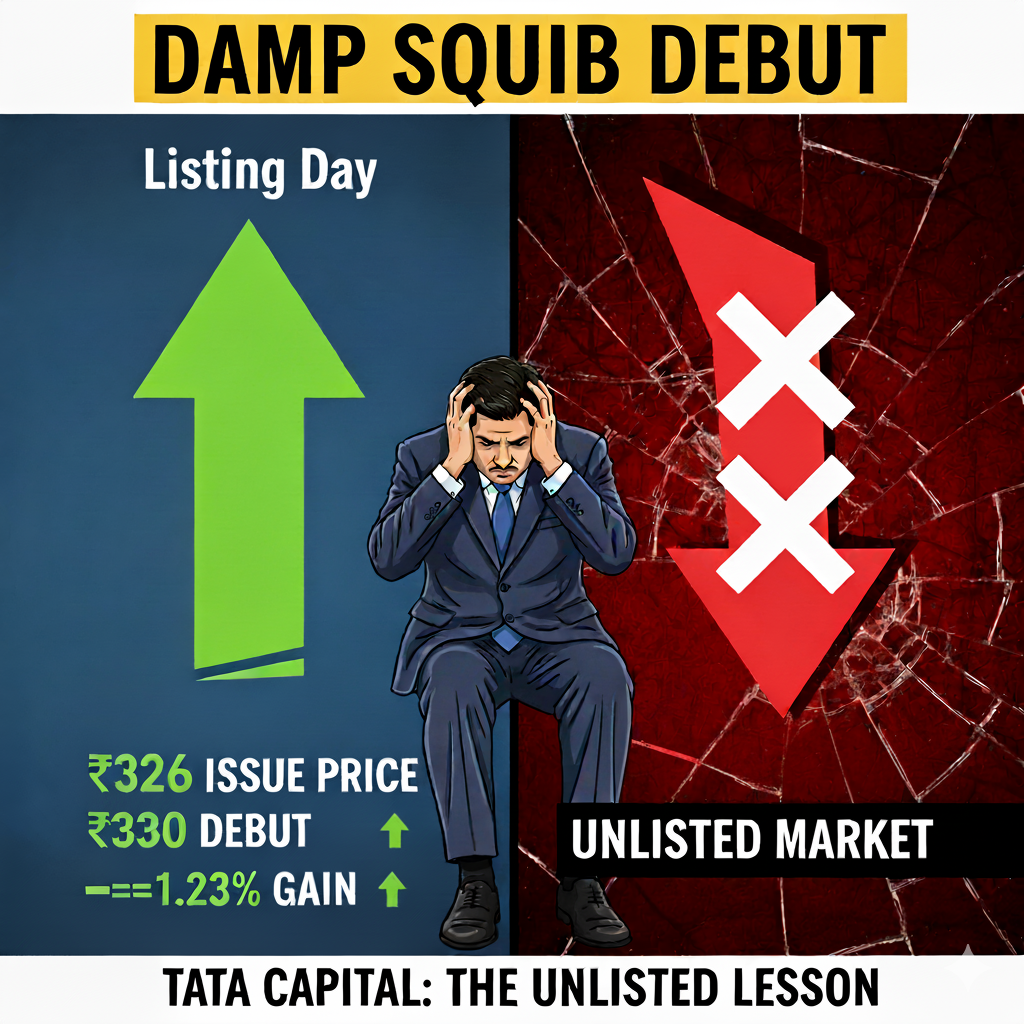
    One of the most anticipated market debuts of the year, the TATA Capital IPO, concluded with a rather lukewarm reception on the stock exchanges today. The scrip listed at ₹330, a mere 1.23% premium over its issue price of ₹326. For the legion of investors who had hoped for significant listing day gains from the TATA powerhouse, the flat opening was a considerable disappointment.

    From Buzz to Bust: The GMP Collapse

    The modest listing didn’t come as a complete surprise to close market watchers. The Grey Market Premium (GMP), an informal indicator of listing sentiment, had been flashing warning signs. After an initial buzz that saw the GMP in the ₹90-₹110 range, it collapsed to virtually zero by the listing day, signaling a dramatic drop in speculative interest. The overall subscription figures, at just 1.95 times, also pointed to moderate, rather than overwhelming, demand.

    The Real Story: A Bubble in the Unlisted Market

    However, the bigger story and a crucial lesson for investors lies in the vast and opaque unlisted market. In the months leading up to the IPO, TATA Capital shares were trading at dizzying heights. Reports show the unlisted share price reached as high as ₹1,155 and was trading around ₹700 just a day before the listing. This pre-IPO frenzy created a perception of massive demand and the potential for a blockbuster listing.

    A Painful Lesson for Pre-IPO Investors

    Investors who bought into this hype and acquired shares in the unlisted space at these inflated prices are now facing a harsh reality. With the stock listing at ₹330, anyone who purchased shares at ₹700 or higher in the unlisted market is now sitting on substantial losses. This situation starkly highlights the inherent dangers of the unlisted securities market. It operates with far less transparency and regulation than the official stock exchanges, making it susceptible to speculative bubbles driven by hype.

    The allure of getting in early on a big name like TATA can be powerful, but the TATA Capital listing demonstrates that this can quickly turn into a costly miscalculation. While the long-term prospects for the company remain a separate discussion, its debut serves as a timely reminder to exercise extreme caution and conduct thorough due diligence before venturing into the high-risk, high-reward world of unlisted securities.

    If you find this article informative, please share it with your network.

  • Wall Street’s Wild Ride: Tariff Talk Sends Markets Tumbling

    Wall Street’s Wild Ride: Tariff Talk Sends Markets Tumbling

    NEW YORK, 10 OCT 2025

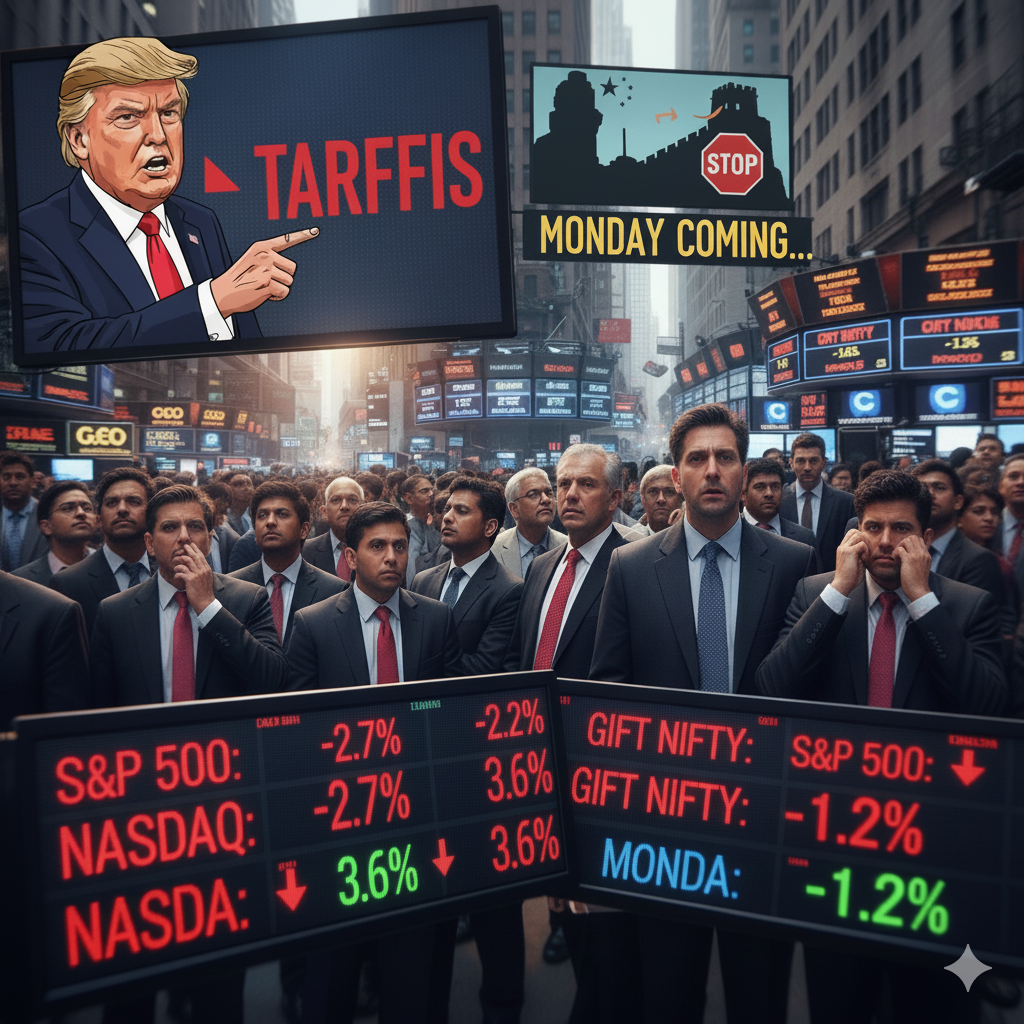
    A calm Friday on Wall Street was shattered by renewed trade war fears, sending stocks into their steepest dive since April. The sell-off was triggered by President Donald Trump’s threat of a “massive increase of tariffs” on China, a move that has investors on edge globally. Now, with the GIFT Nifty also closing in the red, a sense of unease is rippling through India’s Dalal Street as it braces for Monday’s opening bell.

    The downturn in the US was swift and severe. After Trump’s comments, which came in response to China’s new export controls on essential rare earth minerals, the S&P 500 plunged 2.7%. The Dow Jones Industrial Average fell by 878 points, and the tech-heavy Nasdaq Composite took the biggest hit, dropping 3.6%. Tech giants like Apple and Nvidia, which are heavily reliant on Chinese manufacturing and consumer markets, were among the worst performers.

    This sudden return to volatility wasn’t just a Wall Street event; it was a global shockwave. And for investors in India, the signs are worrying.

    The primary concern for Dalal Street is the potential for a major negative opening on Monday. The GIFT Nifty, an early indicator of the direction of the Indian market, closed lower on Friday at 25,249.00, signaling that the bearish sentiment from global markets is already spilling over. Investors in India are now anxiously anticipating a gap-down opening, a scenario where the market opens significantly lower than its previous close, reflecting the overnight turmoil.

    The primary concern for Dalal Street is the potential for a major negative opening on Monday. The GIFT Nifty, an early indicator of the direction of the Indian market, closed lower on Friday at 25,249.00, signaling that the bearish sentiment from global markets is already spilling over. Investors in India are now anxiously anticipating a gap-down opening, a scenario where the market opens significantly lower than its previous close, reflecting the overnight turmoil.

    While the domestic market has shown resilience recently, a global trade war is a powerful headwind that’s difficult to ignore. The key question on every investor’s mind on Dalal Street is whether this is a short-term, knee-jerk reaction or the beginning of a more sustained downturn. As the weekend offers a brief pause, all eyes will be on the opening quotes come Monday morning, with many preparing for a turbulent start to the week.

    ____________________________________________

    If you find this article informative, please share it with your network.