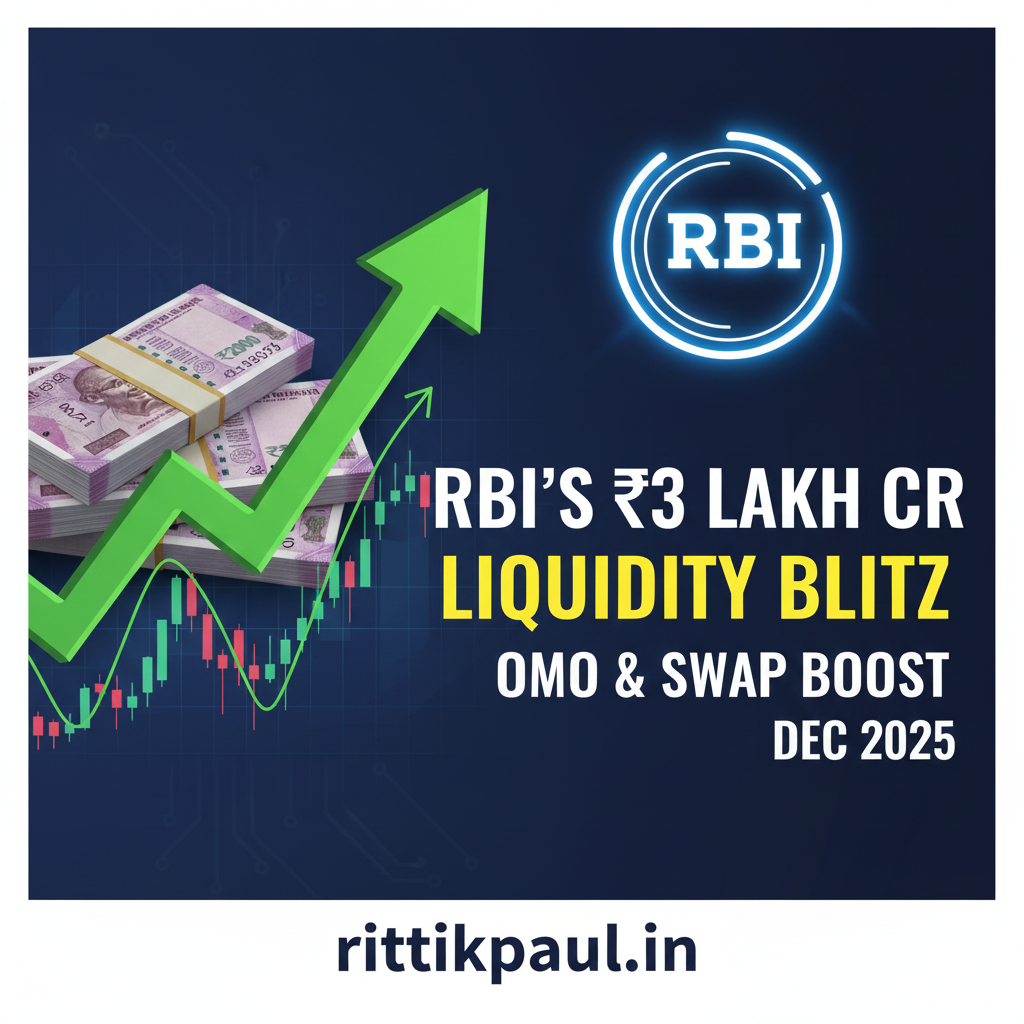
In a significant year-end move, the Reserve Bank of India (RBI) has unveiled a dual-action strategy to tackle tightening financial conditions. With an aggressive focus on injecting durable liquidity, the central bank is set to launch a massive ₹2 lakh crore Open Market Operation (OMO) alongside a $10 billion USD/INR buy-sell swap.
These measures are designed to ensure smooth monetary transmission and prevent a “growth scare” as we head into 2026.
Key Highlights of the RBI Liquidity Measures
To combat system liquidity that recently turned negative, the RBI is deploying two powerful tools:
1. ₹2 Lakh Crore Open Market Operations (OMO)
The RBI will conduct purchase auctions of Government of India securities to pump money directly into the banking system.
- Total Amount: ₹2,00,000 crore.
- Execution: Four tranches of ₹50,000 crore each.
- Schedule: Auctions are slated for Dec 29, 2025, Jan 05, 2026, Jan 12, 2026, and Jan 22, 2026.
2. $10 Billion USD/INR Buy-Sell Swap
To further facilitate rupee liquidity, the RBI will execute a foreign exchange swap auction.
Auction Date: January 13, 2026.
Tenor: 36 months (3 years).
Mechanism: In this buy-sell swap, the RBI initially buys dollars from banks to inject rupees and agrees to sell them back three years later.
Market Implications: What This Means for You
These aggressive actions have immediate consequences for the broader Indian economy and investment landscape.
- Lowering Bond Yields: By purchasing government bonds, the RBI creates demand that helps cool off rising yields. Analysts expect the benchmark 10-year yield to retreat toward the 6.5% mark.
- Currency Stability: With the Rupee recently touching record lows near ₹90 per dollar, these swap operations help stabilize the currency and reduce abnormal volatility.
- Credit Conditions: Ample liquidity ensures that credit remains affordable for housing, vehicles, and SME business loans, fostering a supportive ecosystem for multi-quarter growth.
Why is the RBI Intervening Now?
System liquidity hit a strained period in mid-December 2025, pushing short-term call rates above the policy repo rate. This pre-emptive intervention signals that the RBI is prioritizing macroeconomic stability to meet the productive requirements of a 7.3% projected GDP growth for FY26.
My Take: A Green Signal for Investors?
The RBI’s ₹3 lakh crore liquidity blitz is more than just a banking adjustment; it’s a proactive lifeline for the broader financial ecosystem. By anchoring long-term yields and ensuring a steady cash flow, the central bank is creating a foundation for a stable financial environment in 2026.
Why this matters for your portfolio: It is no secret that the Indian stock market has delivered relatively muted returns over the last two years. Many retail investors have been waiting for a catalyst to break this cycle of consolidation. These liquidity-boosting steps are exactly that catalyst. By lowering borrowing costs and increasing the money supply, the RBI is effectively opening the sluice gates for capital to flow back into the equity markets. For the patient investor, this move significantly increases the likelihood of seeing “green portfolios” once again as we head into the new year.
If you find this article informative, please share it with your network.
Leave a Reply